
Look at a townhome roofline that's all cut up. Valleys, dormers, short runs of gutter. All that water runs to a few small spots. Every one of those spots is a place for an ice dam to build.
My first answer to ice dams is always in the attic. Seal the attic floor. Add insulation. Get the right baffles in and good ventilation moving. On most buildings, that stops them.
Some buildings are so cut up that you can do all of that right and still have ice dams. The cause is the roof design itself. The builder likely didn't see it when the building went up.
So sometimes we need heat tape, the thing I always say to avoid.
Why I don't love heat tape
Heat tape is my last resort.
Fix what's underneath first. Try everything in the attic before heat tape comes up. Learn more about what causes ice dams and how to stop them.
You're attaching something to a roof that was never designed for attachments. Every clip and every fastener goes onto a surface built to shed water.
It typically doesn't last or perform the way people intend. You go cheap, you pay for it. That's why we recommend commercial grade cable, installed by someone who works on these systems professionally. Please reach out if you need a referral. Even then, it wears out.
The electrical is always a concern. You have to know where the power comes from, what else is on the circuit, how far you're running it, and how the system turns on and off.
Weigh what it costs to run against what a leak costs. My very general rule of thumb: if a leak leaves a small stain on a ceiling every three years, so be it. I wouldn't put in a heat tape system for that.
Melted water refreezes somewhere else. Unless you get it all the way to a storm drain as liquid, you're making pools of ice in other areas. That ice can kill plants, heave concrete, and add weight where you don't want it. It creates slip hazards. It can block other drainage from working. If a downspout empties into an underground garage, the water you melted freezes again down there. Water always finds a way.
Consider electrical
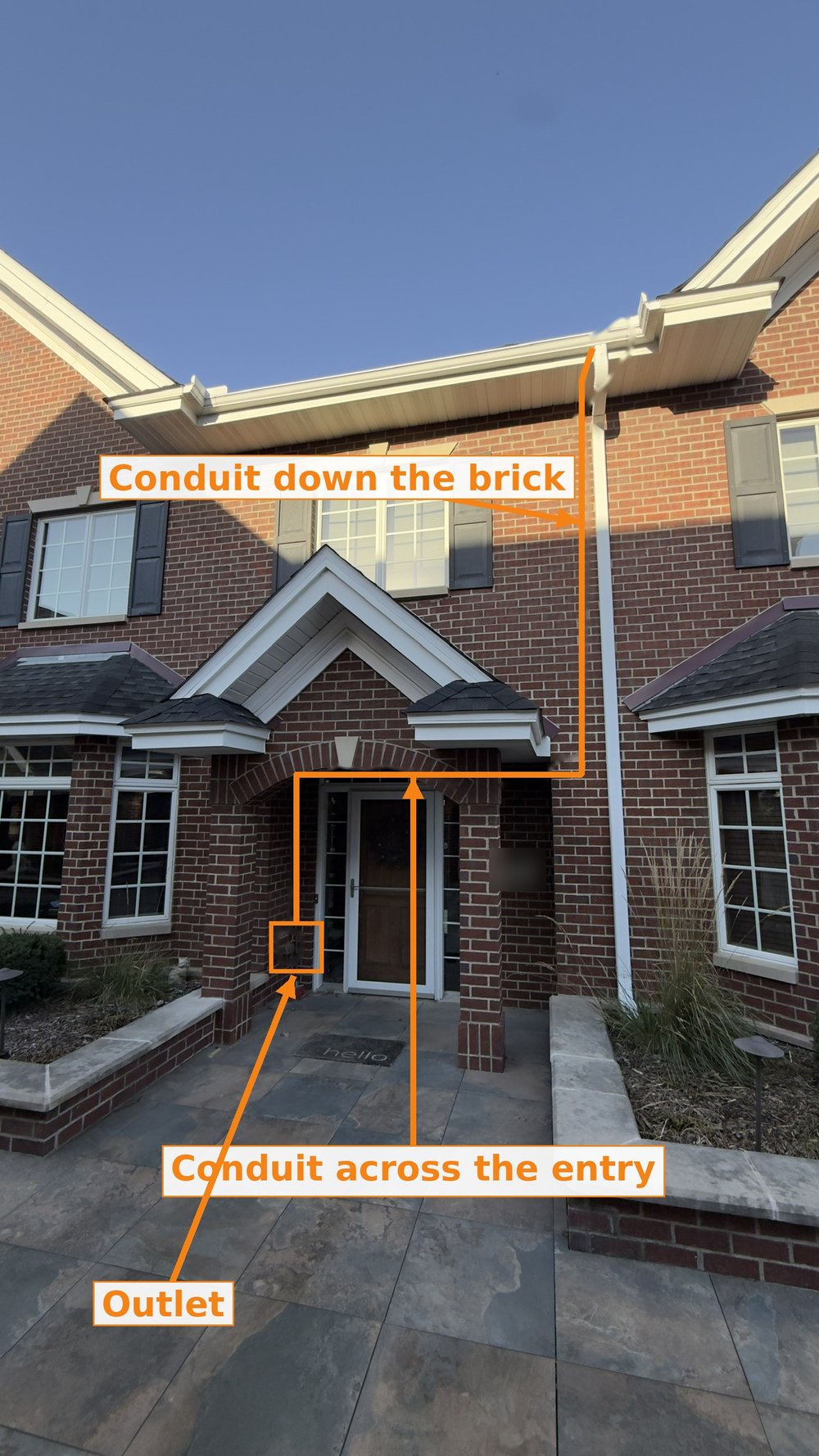
Start with the outlet. Where are you gonna plug this thing in? The outdoor outlet is often down by the front door. The ice dams are two stories up on the other end of the building.
Ground fault protection
A standard GFCI outlet trips at about 5 mA of leakage. Makers of outdoor deicing cable call for 30 mA equipment ground fault protection on each branch circuit. Some plug in kits also accept a 5 mA device. One maker says a 5 mA device can nuisance trip.
Longer runs leak more current, so length alone can trip the outlet. A GFCI that trips all winter can mean the circuit doesn't fit the run.
Keep ground fault protection on the circuit, always. Match the protection to the length of cable you're running.
How are you going to know if the GFCI outlet tripped and the tape is no longer functioning?
Run length
Self regulating cable on 120 volts has a limit per circuit, roughly 100 to 200 feet in the published charts. Breaker size and start up temperature set that limit. At 0°F on a 15 amp breaker, one maker lists 115 feet and another lists 135 feet.
Count the whole heated run. The zigzag along the roof edge, the gutter, and the cable down the downspout and back up all add to it.
The power lead
The plain power wire between the plug and the part of the cable that makes heat is called the cold lead. Factory kits ship with a short one, around 30 inches. The longest plug section I found was 6 feet.
So how do you get from a front door outlet to a roof edge two stories up? With fixed wiring, put in by an electrician. Under the electrical code, a cord set can't substitute for fixed wiring (NEC 400.12). Listed equipment has to be installed the way the maker's instructions say (NEC 110.3(B)). The cable makers say no extension cords.
Heated cable run up a wall burns power and adds leakage with no ice there to melt.
Put the outlet where the cable is
The receptacle goes up near the roof edge with a weatherproof in use cover, so the power run stays short. Check the box for moisture. Check whether the GFCI itself is worn out before you blame the cable.
The circuit
Know the breaker size and what else shares the circuit. On a long feed, voltage drop goes on the list too. Ask whether a dedicated circuit with a 30 mA ground fault breaker is the right fix.
Cable condition and controls
Look at the splices, the end seals, and any cable that's been cut or pinched. Know which cable you have. Constant wattage cable needs a temperature controller. Self regulating cable runs without one.
Either way, add moisture and temperature sensing. The system runs when there's snow and cold, and shuts off when there isn't.
One system for the whole community
Set it up as one system, with an even standard across the community. Get it professionally designed, with a licensed electrician on the power side.
Questions for your electrician
- What breaker size and what ground fault protection does this circuit have?
- What else is on the circuit?
- How long is the heated run, and is it inside the maker's limit for this breaker at our coldest start up temperature?
- Is the power to the roof edge fixed wiring, a cold lead, or a cord?
- Where should the receptacle go, and what cover does it need?
- Does a dedicated circuit with a 30 mA ground fault breaker make sense here?
- Is voltage drop a concern on this feed?
- Which code edition and which permit does our city require for this work?
If you are fighting ice dams, please reach out. We love to diagnose and recommend solutions for these issues.